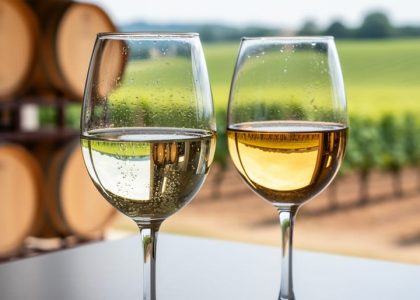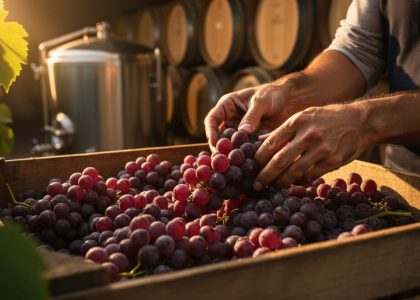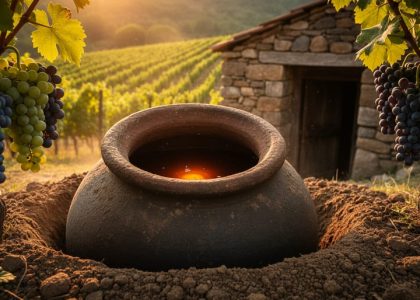


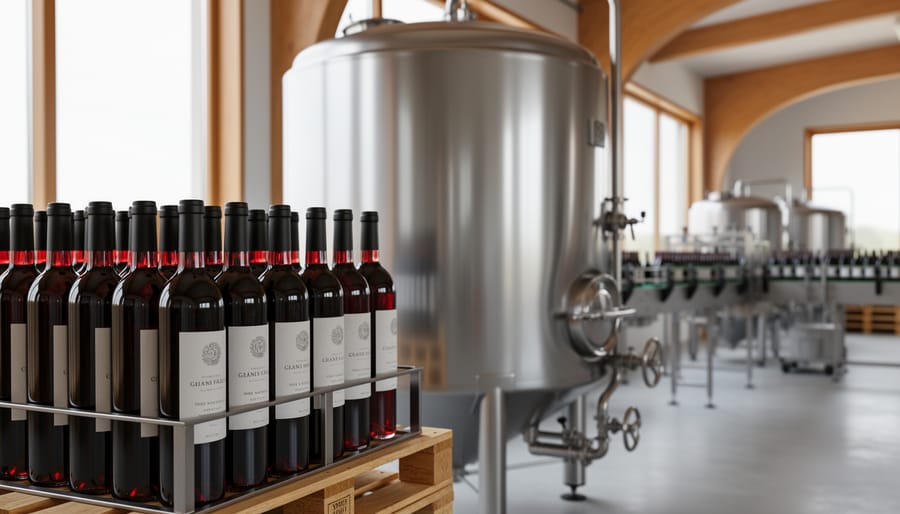
Production wine refers to bottles made at commercial scale by large wineries using efficient, repeatable processes designed to deliver consistent flavor profiles and accessible price points, typically under $20 per bottle. These wines make up the majority of what you’ll find on supermarket and restaurant shelves, crafted by established producers who prioritize volume, reliability, and broad consumer appeal over small-batch experimentation or vineyard-specific expression.
If you’ve ever wondered why your favorite weeknight red tastes exactly the same every time you buy it, or how wineries manage to bottle millions of cases annually while keeping prices stable, production winemaking is the answer. These operations blend grapes from multiple vineyards, regions, or even vintages to maintain a house style year after year. They employ modern technology, from mechanical harvesters and temperature-controlled fermentation tanks to automated bottling lines, allowing them to produce quality wine at a fraction of the cost and labor required by boutique operations.
The category gets an unfair reputation among wine purists, but dismissing production wines as inferior misses the point entirely. Throughout wine history innovation and scale have made wine accessible to broader audiences. Today’s commercial wineries have refined techniques that deliver genuinely enjoyable bottles, perfect for casual dining, hosting friends, or simply unwinding after work. Understanding how production wine works, what standards these wineries follow, and how to choose the best examples gives you practical knowledge that improves everyday wine decisions without emptying your wallet.
Production wine represents the dominant force in today’s global wine industry, accounting for the vast majority of bottles that reach retail shelves, restaurants, and consumers worldwide. At its core, production wine refers to commercial-scale wine production operations that create wine in volumes typically exceeding 50,000 cases annually, that’s 600,000 bottles or more each year. These wineries prioritize consistency, efficiency, and broad market distribution over the small-lot, terroir-focused approach of boutique producers.
The philosophy behind production winemaking centers on delivering a reliable product that tastes the same year after year. Rather than expressing the unique character of a single vineyard or vintage, production wineries blend grapes from multiple sources, often across different regions or even states, to achieve a house style that consumers recognize and trust. This approach relies heavily on technology: temperature-controlled stainless steel tanks, commercial yeast strains, mechanical harvesting equipment, and laboratory analysis that monitors every stage from crush to bottling.
Consider the difference between a Napa Valley estate winery producing 3,000 cases from its own 40 acres versus a major brand like Barefoot or Yellow Tail, which ships millions of cases annually. The estate winery hand-sorts fruit, ferments in small French oak barrels, and crafts wine that reflects that specific vintage’s weather and soil. Production wineries, by contrast, source fruit through contracts with dozens or hundreds of growers, process tons of grapes per hour through crusher-destemmers, and use blending trials to replicate the previous year’s flavor profile regardless of harvest conditions.
Artisan and boutique categories fall between these extremes, typically producing 5,000 to 50,000 cases with more hands-on methods but less emphasis on vintage variation than true estate wineries. Production wine occupies the high-volume end of this spectrum, where scale and consistency define success. Understanding this distinction helps you set appropriate expectations when selecting wines and recognizing that production methods serve a legitimate purpose in making wine accessible and affordable for everyday enjoyment.
Production wineries typically cross the 50,000-case threshold annually, with many major brands producing hundreds of thousands or even millions of cases per year. This volume enables nationwide and international distribution through established three-tier systems (producer to distributor to retailer), direct relationships with major retail chains, and export partnerships spanning dozens of countries. The economics are straightforward: large-scale operations spread fixed costs, vineyard contracts, equipment, facilities, staffing, across enormous output, reducing per-bottle production costs dramatically. A production winery might pay $2-4 per bottle in direct costs where a boutique producer pays $8-12, creating competitive pricing power at retail. This efficiency funds the infrastructure for consistency, including lab analysis, quality control teams, and the blending programs that ensure each vintage tastes recognizably like the brand’s house style. Understanding how blending works clarifies why production wineries source fruit from multiple regions rather than single vineyards. Market presence translates to shelf dominance: production wines occupy the majority of grocery, big-box, and chain restaurant wine lists, making them the industry’s volume backbone and most consumers’ everyday drinking experience.
Production wineries rely on specialized equipment and systematic processes to maintain quality while handling thousands of tons of grapes. The technology isn’t about cutting corners, it’s about precision at scale.
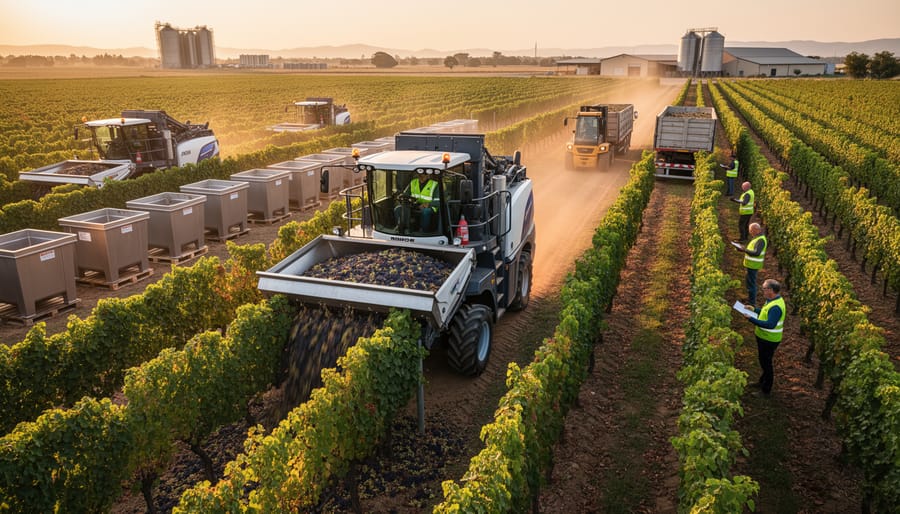
Mechanical harvesters have transformed vineyard operations for large wineries. These machines shake vine trunks to dislodge ripe grapes, collecting fruit in hours that would take hand-pickers days. While critics worry about leaf debris and damaged berries, modern harvesters use optical sorters and vibration controls to minimize waste. Most production wineries harvest at night when cooler temperatures preserve grape aromatics and slow oxidation before processing begins.
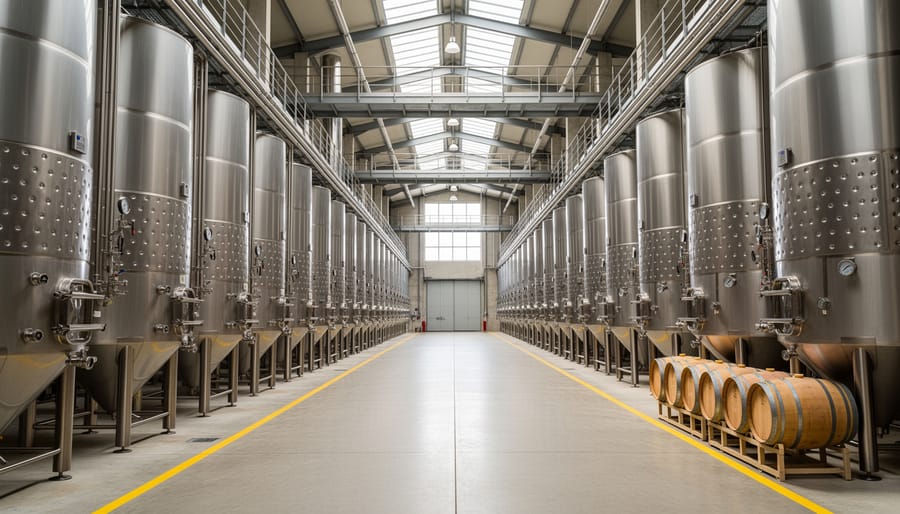
Temperature-controlled fermentation tanks are non-negotiable for consistency. Stainless steel vessels ranging from 10,000 to 50,000 gallons allow winemakers to monitor and adjust fermentation temperatures within one degree. White wines typically ferment at 50-60°F to preserve delicate fruit flavors, while red wines run warmer at 75-85°F to extract color and tannins. Automated cooling jackets and programmable controls mean a single technician can oversee dozens of tanks simultaneously, catching problems before an entire batch spoils.
Laboratory analysis happens at every stage. Production wineries test brix levels before harvest, monitor pH and acidity during fermentation, and verify alcohol content before bottling. Gas chromatography identifies potential off-flavors from volatile compounds, while microbiological testing catches spoilage organisms. This data-driven approach removes guesswork, ensuring each vintage hits the same flavor profile regardless of weather variations.
Crossflow filtration and centrifuges clarify wine without the labor-intensive racking traditional cellars use. These systems remove yeast cells, bacteria, and suspended particles in continuous flows, producing the bright, stable wines consumers expect on retail shelves year-round.
Production wineries orchestrate a complex operation that transforms tens of thousands of tons of grapes into consistent, market-ready wine each vintage. The process begins months before harvest, when winemaking teams finalize sourcing agreements with contract growers across multiple regions. These contracts specify grape varieties, tonnage requirements, delivery windows, and quality parameters like sugar levels and acidity. Unlike estate wineries that control every vine, production facilities blend fruit from diverse sources to achieve target flavor profiles and meet volume commitments.
Harvest logistics operate on industrial timelines. Refrigerated trucks deliver grapes around the clock during peak season, often from vineyards hundreds of miles apart. Mechanical harvesters work 24-hour shifts to pick fruit at optimal ripeness, depositing grapes directly into gondolas that head straight to the crush pad. Upon arrival, loads pass through quality checkpoints where lab technicians measure Brix, pH, and visual condition before acceptance. Substandard fruit gets rejected or rerouted to lower-tier labels.
The crush and fermentation stage scales up traditional methods. Destemmer-crushers process 50 tons per hour, feeding must into stainless steel tanks that hold 10,000 to 100,000 gallons. Temperature-controlled fermentation follows programmed cycles, with sensors monitoring sugar conversion every few hours. Automated pump-over systems circulate juice through cap layers on strict schedules, extracting color and tannins without manual labor. Press runs use bladder or continuous presses that handle multiple tons in a single cycle, separating free-run and press wines for later blending decisions.
Blending for consistency demands precision. Winemakers assemble trial blends from dozens of tank lots, adjusting percentages to match established house profiles that consumers expect year after year. Lab analysis confirms pH stability, alcohol levels, and residual sugar before batches combine in holding tanks. This stage separates production winemaking from small-lot artisan work, the goal is replicable quality, not vintage variation.
Stabilization and filtration prepare wine for bottling and shelf life. Cold stabilization tanks drop wine to near-freezing temperatures, precipitating tartrate crystals that would otherwise form in bottles. Fining agents clarify the wine, then multi-stage filtration removes remaining solids and microbes. Many production wineries employ crossflow filtration or sterile cartridge systems that guarantee microbiological stability without pasteurization, preserving fresh fruit character while ensuring safety across warm distribution channels.
Bottling lines run at speeds measured in bottles per minute, not per hour. Automated equipment rinses bottles, fills to precise volumes, inserts closures (cork, screwcap, or synthetic), applies capsules, and affixes labels in continuous motion. Vision systems inspect every bottle for fill level, label alignment, and closure integrity. Quality assurance teams pull random samples throughout runs, conducting sensory checks and measuring dissolved oxygen to catch defects before pallets ship.
Throughout this pipeline, wine sustainability practices intersect with efficiency goals. Water reclamation systems reuse crush-pad runoff, solar arrays power refrigeration, and pomace composting diverts waste from landfills. The organizational framework coordinates winemaking, lab work, cellar operations, maintenance crews, and logistics under one roof, a manufacturing environment that still honors grape quality as the foundation of every bottle that reaches market.
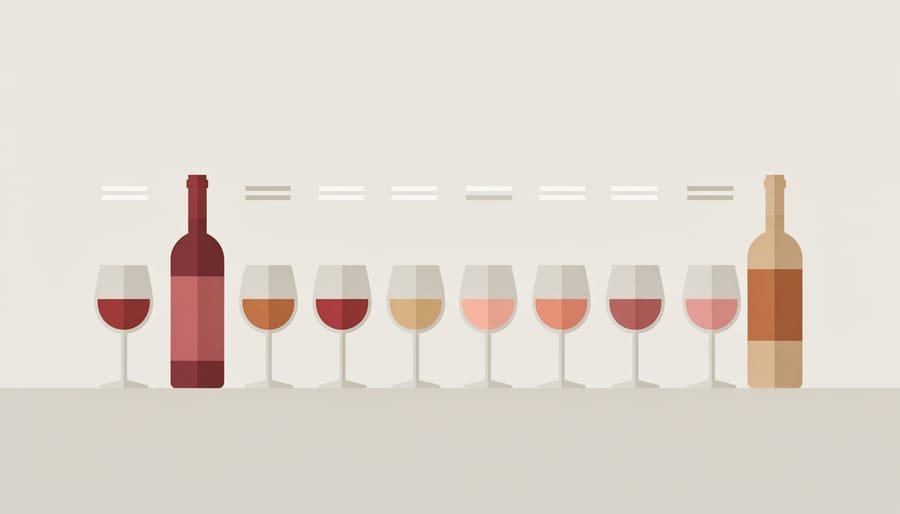
Choosing production wine doesn’t mean sacrificing quality, it means understanding what you’re buying and matching the bottle to your needs. The best production wines deliver reliable enjoyment at fair prices, but label literacy and realistic expectations are your tools for navigating the category successfully.
Start with the label. Look for vintage dates, which signal a producer’s confidence in year-to-year consistency and provide transparency about what’s inside. Regional blending is common in production wine, a bottle labeled “California” may draw grapes from multiple counties, so pay attention to appellation specificity. Narrower designations like “Napa Valley” or “Russian River Valley” typically indicate more focused sourcing and often higher quality than broader state-level labels. House styles emerge across a producer’s portfolio: certain brands consistently favor riper fruit profiles, others lean toward restraint and balance. Tasting several wines from the same producer reveals their signature approach and helps you decide if their style aligns with your palate.
Value hunting requires context. Compare production wines within the same price tier rather than against boutique releases at triple the cost. A fifteen-dollar production Chardonnay won’t taste like a sixty-dollar estate bottling, but it can absolutely taste good and serve its purpose. Think about the wine’s role: production wines excel for casual weeknight dinners, cooking with wine or parties where volume matters. They’re less suited to special occasions demanding complexity and age-worthiness.
When selecting quality production wines, keep these strategies in mind:
Flavor consistency is production wine’s strength. If you enjoy a bottle this month, the next one should taste nearly identical. Most production wines are designed for immediate consumption, drink them within two years of purchase. A few premium-tier production wines, especially structured reds and dry wine styles with good acidity, can handle three to five years of bottle age, but extended cellaring isn’t their forte. When in doubt, buy to drink soon and you’ll get the experience the winemaker intended.
When you buy a bottle of production wine, you’re entering a transaction governed by established consumer protections and industry standards. Understanding these rights helps you navigate the marketplace with confidence and know what recourse you have if something goes wrong.
Federal and state agencies regulate wine labeling to ensure accuracy and transparency. In the United States, the Alcohol and Tobacco Tax and Trade Bureau (TTB) requires that labels accurately disclose alcohol content (within a narrow tolerance), origin claims, and any allergens like sulfites. If a bottle claims “California” on the label, at least 75% of the grapes must come from that state. Appellation-specific claims like “Napa Valley” require 85% of the fruit to originate there. These rules protect you from misleading marketing and give you reliable information to guide your purchase.
Production wineries owe you a product that’s merchantable and free from defects. That means the wine should be sound when you open it, no spoilage, contamination, or premature oxidation that renders it undrinkable. If you encounter a flawed bottle, most retailers will accept returns with proof of purchase, especially for obvious faults. Reputable wineries also maintain customer service lines and will often replace defective bottles or issue refunds directly if you contact them with a legitimate complaint.
Return policies vary by state and retailer. Some jurisdictions prohibit alcohol returns for health and safety reasons, while others allow exchanges for defective products within a reasonable window. Always check your receipt and ask about the store’s policy before leaving. Online wine retailers typically offer return windows for faulty bottles, though you may need to provide photos or detailed descriptions of the defect.
You’re not entitled to a refund simply because you dislike a wine’s style or flavor profile. Personal taste is subjective, and a wine that doesn’t suit your palate isn’t defective. However, if a bottle is genuinely spoiled or misrepresented, you have legitimate grounds for recourse. Keep your receipt, act promptly, and communicate the issue clearly to the seller or producer. Most businesses in the wine industry value their reputation and will work with you to resolve the problem fairly.
If you want to move beyond tasting and truly understand commercial winemaking, a range of trusted resources exists for enthusiasts at every level. The Wine Institute () offers industry insights, reports, and educational materials on California winemaking, while regional trade associations in Washington, Oregon, and international markets publish similar resources. For structured learning, the Wine & Spirit Education Trust (WSET) provides globally recognized courses from beginner to diploma level, covering production methods, quality assessment, and the business side of wine. The Court of Master Sommeliers and the Society of Wine Educators offer parallel certification tracks with strong commercial wine components.
Consider these actionable next steps for deeper engagement:
For specific product questions, most large wineries maintain customer service lines and email contacts on their websites, they can address vintage details, winemaking choices, and availability. Local wine shops with trained staff offer personalized consultations that bridge the gap between textbook knowledge and what’s actually in your glass. Many production wineries also host virtual tastings and webinars, making expert guidance more accessible than ever.
Production wineries must meet specific regulatory and operational thresholds to legally produce and sell wine at commercial scale. In the United States, any entity making wine for sale needs a federal Basic Permit from the Alcohol and Tobacco Tax and Trade Bureau (TTB), plus state-level winery licenses that vary by jurisdiction. Most states require proof of bonding, facility inspection approval, and compliance with local zoning laws before issuing production licenses.
Volume thresholds differ by region. The TTB doesn’t set a minimum production level for the permit itself, but many state programs distinguish between small farm wineries (often capped at 50,000 gallons annually) and commercial production facilities with higher limits or no caps. You’ll need documented vineyard sources, whether owned land, long-term leases, or purchase contracts with growers, to demonstrate reliable grape supply.
Essential documentation includes facility blueprints showing winemaking and storage areas, equipment lists, water rights or utility confirmations, and waste disposal plans. Some states mandate certified lab access for analysis and tax reporting. Large-scale operations often require environmental impact assessments and special permits for wastewater discharge.
If you’re establishing a production winery, consult both federal TTB guidelines and your state’s alcohol control board early, application timelines can stretch six months to over a year depending on complexity and local approval processes.
Production wine isn’t something you “apply for” as a consumer or hobbyist, it describes a business scale and operational approach that commercial wineries develop over time. If you’re a winemaker or entrepreneur aiming to enter production-level winemaking, the path involves licensing, compliance, and infrastructure decisions rather than a single application process.
Start by securing the necessary permits from your country’s regulatory body: in the U.S., that’s the Alcohol and Tobacco Tax and Trade Bureau (TTB); in Canada, provincial liquor authorities; in the EU, national wine boards. You’ll need a bonded winery license, which requires submitting facility plans, equipment lists, and production forecasts. Expect background checks and fees that vary by jurisdiction.
Next, establish contracts with grape growers or vineyard operators if you’re not estate-based; many production wineries operate under a négociant model sourcing fruit from multiple regions. Secure insurance, create a quality control framework, and file label approvals for each wine SKU before bottling.
Ongoing compliance includes monthly production reports, tax filings on alcohol volume, and adherence to labeling laws. Large-scale operations also invest in food safety certifications and environmental permits for wastewater and emissions.
This isn’t a one-time process, it’s continuous regulatory engagement that grows with your production volume.
Quality doesn’t correlate directly with production volume, it depends on the winery’s standards, sourcing decisions, and investment in both vineyard management and cellar technology. Many large-scale producers maintain rigorous quality protocols and source grapes from respected appellations, delivering wines that compete favorably at their price points. The difference lies more in style philosophy than inherent inferiority: production wineries prioritize consistency and accessibility, while smaller estates may pursue vintage variation and singular expressions of place.
Not necessarily. Large-scale wineries often have access to premium vineyard sources, advanced quality control, and skilled winemaking teams. Quality depends on the producer’s standards and grape sourcing, not volume alone.
Yes. Many large producers craft reserve-tier or single-vineyard bottlings with the structure and balance to age gracefully for a decade or more. Check vintage reviews and producer track records for guidance.
Multi-region blends emphasize varietal character and house style over specific site expression. Winemakers blend fruit from different areas to achieve consistent flavor profiles rather than showcase a single vineyard’s unique characteristics.
Production wineries typically own or control vineyard sources and operate their own winemaking facilities. Négociants buy finished wine or grapes from growers, then blend and bottle under their own label without owning vineyards.
Understanding terroir in the context of blended production wines requires a shift in perspective. When a winery blends fruit from Napa Valley, Sonoma, and the Central Coast into a single Cabernet Sauvignon, the goal isn’t to express a particular hillside’s soil or microclimate. Instead, the winemaker uses blending to build a complete flavor profile, coastal vineyards contribute acidity and freshness, valley sites add body and ripeness, hillside parcels bring structure. The resulting wine reflects the producer’s vision and blending expertise more than any single location’s identity.
Aging potential in production wines varies widely by tier and variety. Entry-level offerings intended for immediate consumption may lack the tannin, acidity, or concentration needed for long-term cellaring. However, many large producers offer reserve programs, single-vineyard selections, or library releases specifically designed to evolve with age. Look for structured reds with balanced acidity, modest alcohol levels, and vineyard designations from respected regions. Producers with decades-long track records in premium categories, such as established Napa labels or respected Australian estates, often demonstrate consistent aging curves across vintages, making their top-tier production wines reliable cellar candidates for eight to fifteen years or more.
Production wine deserves a place in your glass and in the broader conversation about winemaking. These large-scale operations supply the bottles that introduce millions to wine, stock restaurant lists from casual bistros to mid-tier dining rooms, and deliver consistent, enjoyable experiences at price points that make regular consumption feasible. Dismissing production wines as inferior misses the sophistication required to blend grapes from multiple sources into a cohesive whole, the technical mastery needed to maintain quality across hundreds of thousands of cases, and the skill that goes into creating reliable house styles year after year.
Understanding production winemaking deepens your appreciation for the entire spectrum of wine. The methods you’ve explored, mechanical harvesting, temperature-controlled fermentation, stabilization protocols, blending strategies, represent real achievements in agricultural science and process management. They’re different tools applied to different goals, not shortcuts that compromise integrity. Some production wines offer remarkable value. Others fall flat. Your job as a curious drinker is to taste with awareness, not prejudice.
As you continue exploring wine production basics, bring this perspective to the vineyard, the cellar, and the shop. Ask how a wine was made, where the grapes were sourced, what the winemaker aimed to achieve. Let your palate, not the production scale, guide your judgment. Every bottle tells a story about choices, trade-offs, and the pursuit of balance between craft and commerce.